Someone in a WhatsApp group for Singapore SME owners recently asked if they should “get an AI agent” for their customer service team. Three vendors replied within the hour. All three sent decks. All three used the phrase “AI agent.” And if you looked closely at what they were actually selling — two of them were flogging a WhatsApp chatbot with a few canned responses and a hand-off button. The third was selling a slightly fancier version of the same thing, dressed up with a ChatGPT logo.
This is the problem. The word “agent” has been kidnapped, and business owners across Malaysia and Singapore are paying the ransom.
Here is the truth: a chatbot is not an AI agent. And confusing the two could be the most expensive mistake your business makes in 2026.
The Difference in One Sentence
Let us cut through the jargon.
A chatbot answers questions. An AI agent completes tasks.
A chatbot responds to inbound visitors using pre-written scripts and cannot initiate contact, personalise messages at scale, or take action in a CRM or calendar. An AI agent receives a goal and takes a sequence of actions across multiple tools to reach it without waiting for prompts.
Think of it this way: a chatbot is like a smart intern who answers your questions. An AI agent is a smart intern you can hand a whole task to.
A chatbot tells you how to follow up with a lead. An AI agent actually follows up with the lead, updates your CRM, and schedules a call. A traditional chatbot might tell you a refund is being processed. An AI agent can check whether it is allowed, process the return, update company records, and involve a human only if something unusual happens.
Chatbots reply. AI agents work. One saves minutes. The other saves people-hours.
What a Chatbot Actually Does
A chatbot is a question-and-answer tool. A visitor types something, the bot finds the closest matching answer, and it replies. That is the full loop.
It follows scripted flows and waits for user input — it responds but does not act. A chatbot takes your input and returns an output. That is it. You type “what are your opening hours,” it replies “9am to 6pm.” You ask “do you have this in blue,” it says “let me connect you to a human.”
Maybe it is scripted with a decision tree. Maybe it is powered by GPT-4 and sounds remarkably articulate. Does not matter. If the system waits for you to say something, responds, then stops — that is a chatbot. A very nice chatbot, perhaps. But a chatbot.
Where chatbots fit:
Answering FAQs on a website or Facebook page
Sharing business hours, location, or pricing
Collecting a name and phone number before routing to a human
Low complexity, low risk tasks
Simple lead capture forms
Where chatbots break down:
They cannot make decisions
They cannot complete multi-step workflows
They require humans to finish the job
Think of a kedai runcit in Subang Jaya that gets 80 messages a day asking “still open?” or “ada delivery tak?” A chatbot handles those in seconds and frees the owner to focus on the counter. That is genuine value.
The ceiling, though, is clear. A chatbot waits. It does not go out and do anything on your behalf. Once the conversation ends, it stops. You still need a human to follow up, qualify, and close.
What an AI Agent Does Differently
An AI agent is a fundamentally different thing. An agent is autonomous. It does not just respond — it acts.
An AI agent is designed to own a task, not just a conversation. It can:
Understand intent and context
Decide the next action based on rules and data
Interact with systems like CRM, spreadsheets, email, and APIs
Complete tasks end-to-end with guardrails
Escalate to humans only when needed
An AI agent is an autonomous system that perceives its environment, reasons towards a goal, takes action using available tools, checks the result, and adapts — without requiring a human to approve every step.
Think of it like hiring a very capable employee who never sleeps. You give them a goal. They figure out the steps, execute them, handle unexpected situations, and report back when done.
How an AI agent works:
AI agents operate through a four-stage loop that repeats until the goal is achieved:
Perceive: The agent takes in information — from emails, databases, forms, calendars, websites, or APIs.
Reason: It analyses what it knows and decides what to do next based on the goal.
Act: It executes an action — sending a message, updating a record, generating a report, booking a slot.
Adapt: It evaluates the result and adjusts its next step accordingly.
This loop is what separates agents from simpler automation tools. Zapier runs a fixed workflow. An AI agent handles situations it was not explicitly programmed for.
Side-by-Side Comparison
| Area | Chatbot | AI Agent |
|---|---|---|
| Primary role | Answer questions | Complete tasks |
| Takes action | No | Yes |
| Multi-step tasks | No | Yes |
| Adapts mid-task | No | Yes |
| Uses external tools | Limited | Yes — apps, APIs, databases |
| Decision making | Very limited | Plans and chooses next best action |
| System integration | Optional | Core requirement |
| Human dependency | High | Low, with defined override |
| Business impact | Minor efficiency | Scalability and revenue lift |
A Real-World Example: The Return Request
Here is a concrete example that illustrates the difference perfectly.
A chatbot doing its best chatbot impression:
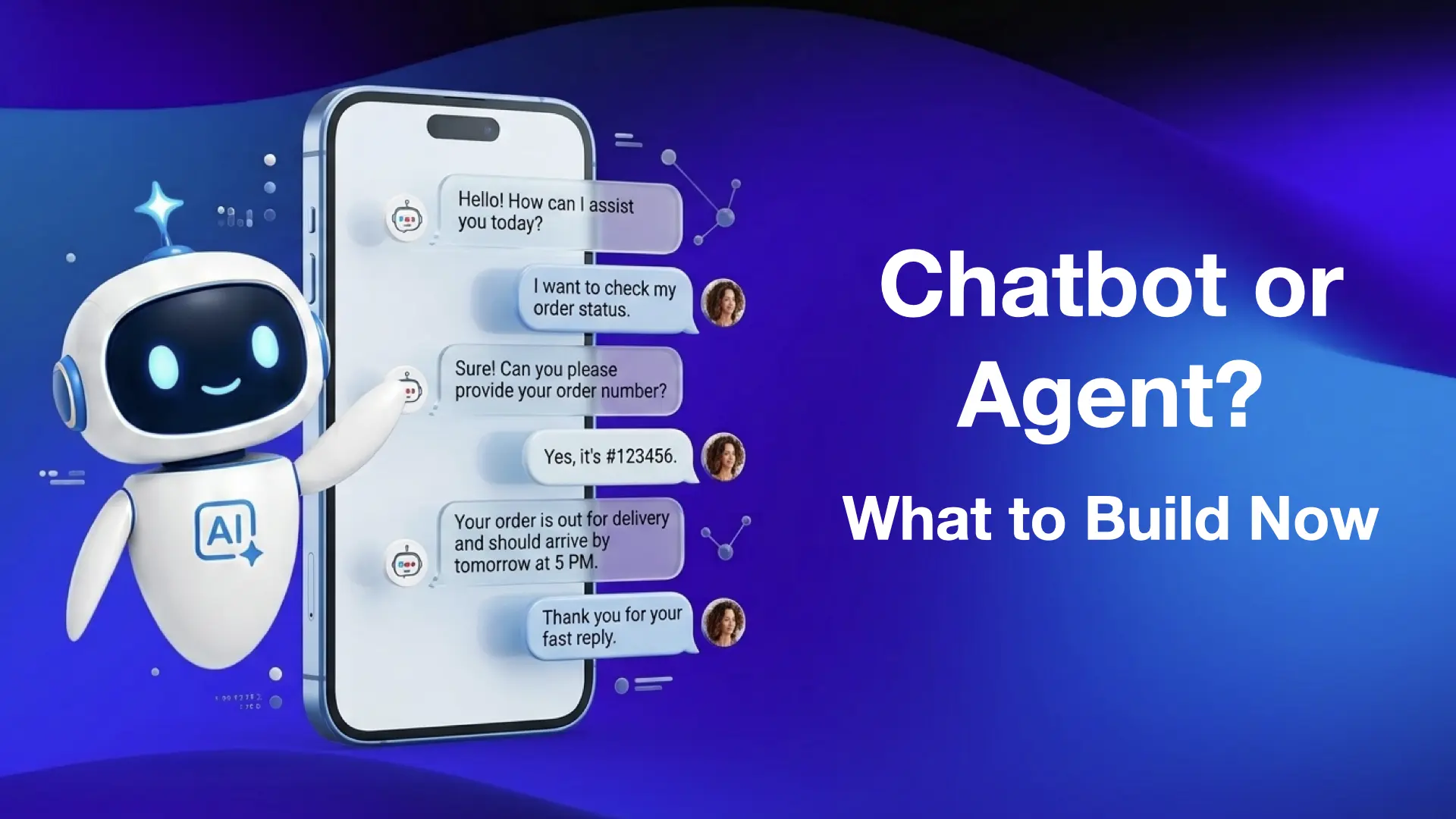
A retail company deploys a “customer service AI agent” on their website. A customer types in “I want to return my order.” The bot asks for the order number. Customer provides it. Bot says “Thank you, our team will be in touch within 2 business days.” End of interaction.
That is a chatbot. A polite one, sure. But it did not check the order status, did not verify if the return window was still valid, did not raise a return request in the backend system, did not notify the warehouse. It collected information and stopped. A human still has to do everything that matters.
An actual AI agent in the same scenario:
Customer says “I want to return my order.” The agent pulls the order record from your e-commerce system. Checks the purchase date against your return policy. Verifies the item is eligible. Generates a return authorisation number. Sends the customer a prepaid shipping label via email. Logs the return in your inventory system. Flags it to the warehouse team. Updates your CRM.
Done. No human touched it.
That is not a chatbot. That is an agent.
Why Malaysian and Singaporean SMEs Are Making the Switch
The numbers tell a clear story.
In Malaysia, businesses are experimenting with chatbots, predictive analytics, and AI-powered customer tools — but the next phase will demand more than just experimentation. By the end of 2026, 40% of business applications are expected to feature some form of autonomous AI agent, up from less than 5% in 2025. The market is growing at a 45% CAGR, and Malaysian businesses are already deploying AI agents in customer service, sales, operations, and finance.
Alibaba.com recently launched “Accio Work,” an agentic AI business team designed specifically for SMEs in Malaysia — a plug-and-play AI agent team that automates end-to-end business operations. This is not a niche trend. This is the mainstream.
In Singapore, DBS rolled out an agentic AI assistant to 350,000 of its corporate clients in July 2026, including SMEs. The government’s refreshed Retail Industry Digital Plan now places a stronger focus on AI adoption across all areas of retail, including AI concierge and chatbots for customer engagement, AI-driven demand forecasting, and generative AI tools.
Across both markets, SMEs are under pressure to do more with less. Labour costs rise. Skilled talent is scarce. Yet most companies still deploy chatbots and hope for agent-grade results. That gap is why AI experiments stall after launch.
Why Many AI Projects Disappoint
From real client experience across Malaysia and Singapore: 87% of AI initiatives never scale beyond a pilot.
Failure is rarely model accuracy — it is workflow design and ownership.
The common mistake: “Let us add a chatbot and reduce manpower.”
The reality:
The chatbot answers.
Humans still do the work.
Nothing meaningful changes.
Chatbots reduce typing. AI agents reduce work.
We see this pattern repeatedly with Malaysian SMEs who come to us after failed chatbot experiments. The fix is almost always the same: redesign the workflow first, then introduce AI that owns the outcome.
When a Chatbot Is Enough
Choose a chatbot when:
You only need Q&A or form-style lead capture
Volume is low and risk is low
No backend systems need updates
Chatbots are fine tools — when expectations match what they can do.
If your only requirement is answering the same ten questions day after day — business hours, location, pricing, delivery options — a chatbot will serve you well. Basic chatbot tools sit roughly in the range of RM 100 to RM 500 a month depending on the platform and message volume.
When to Deploy an AI Agent
Prioritise an AI agent when:
Tasks repeat daily and follow consistent steps
Decisions are rule-based but time-consuming
Growth depends on hiring more people to keep up
Compliance or audit trails matter (so every action is logged)
This is where AI starts delivering real ROI.
An AI agent can handle incoming enquiries across WhatsApp, email, and your website — simultaneously, around the clock. It can qualify leads, book appointments, update CRM records, generate reports, and notify your team only when a human is actually needed.
More capable AI agents with full system integration typically run RM 500 to RM 2,000 a month in the Malaysian market. The ROI? Businesses deploying structured AI automation report reducing operational overhead by 20–35% within six months.
The Cost of Getting It Wrong
The gap between expectations and reality is expensive.
Malaysian SMEs using generic, un-governed AI tools are unknowingly sitting on a 29% compliance risk. Beyond compliance, there is the opportunity cost: business owners are spending 2–5 hours a day on tasks that could be fully automated. Lead lists go cold because follow-up is slow. Client reports take half a day instead of 28 minutes.
If you deploy a chatbot when you need an AI agent, you are not saving money — you are wasting it on a solution that does not solve your problem. And if you deploy an AI agent when a simple chatbot would suffice, you are overcomplicating and overspending.
The distinction matters more than the technology label.
The Strategic Question for 2026
The question in 2026 is not “Can AI help?” — it is “Which tasks can AI reliably run without adding headcount?”
Don’t ask what AI can say. Ask what AI can own.
Understanding the difference between chatbots and AI agents early keeps budgets, timelines, and stakeholder trust on track.
A chatbot talks, but it does not work. An AI agent works. And in 2026, the businesses that understand this distinction will be the ones pulling ahead — while everyone else wonders why their AI experiment “didn’t really change anything.”
Who is JustSimple.AI?
At JustSimple.AI, we are a Malaysian AI Automation Agency dedicated to helping businesses navigate and thrive in this new era. We understand the unique challenges and opportunities of the local market, including considerations like regional search intent and the nuances of the Singaporean and Malaysian consumer base.
We don’t just offer generic tools; we offer transformation. Our team of experts helps you build and deploy these intelligent, semantic workflows, moving you from manual, outdated SEO practices to an optimized, revenue-focused system. We cut through the technical jargon and focus on one thing: getting your business found by both humans and AI models.
Your Next Step
At justsimple.ai, we help Malaysian and Singaporean SMEs navigate this decision with clarity. We do not sell you a chatbot and call it an agent. We help you understand your actual workflow needs and deploy the right solution — whether that is a simple chatbot for FAQ handling or a full AI agent that automates end-to-end processes.
Start by understanding where you stand today. Our Free AI Visibility Evaluation Tool gives you a comprehensive assessment of your AI readiness and competitive positioning — so you know exactly where to focus your efforts.
Ready to automate smarter? Our AI Vibe Coding Apps solutions are designed specifically for SMEs who want to accelerate office automation and marketing automation for better efficiency — without the complexity and cost of enterprise-grade solutions.
Not sure which solution fits your business? Book your free consultancy session with our team today. We will audit your workflows, identify your highest-yield opportunities, and help you build the right AI solution — chatbot, AI agent, or both.
The difference between a chatbot and an AI agent is the difference between answering questions and getting work done. Which one is your business building?
The brands that win in the AI search era will not be the ones with the most content. They will be the ones whose content AI engines trust, cite, and name. The question is: will your brand be one of them?