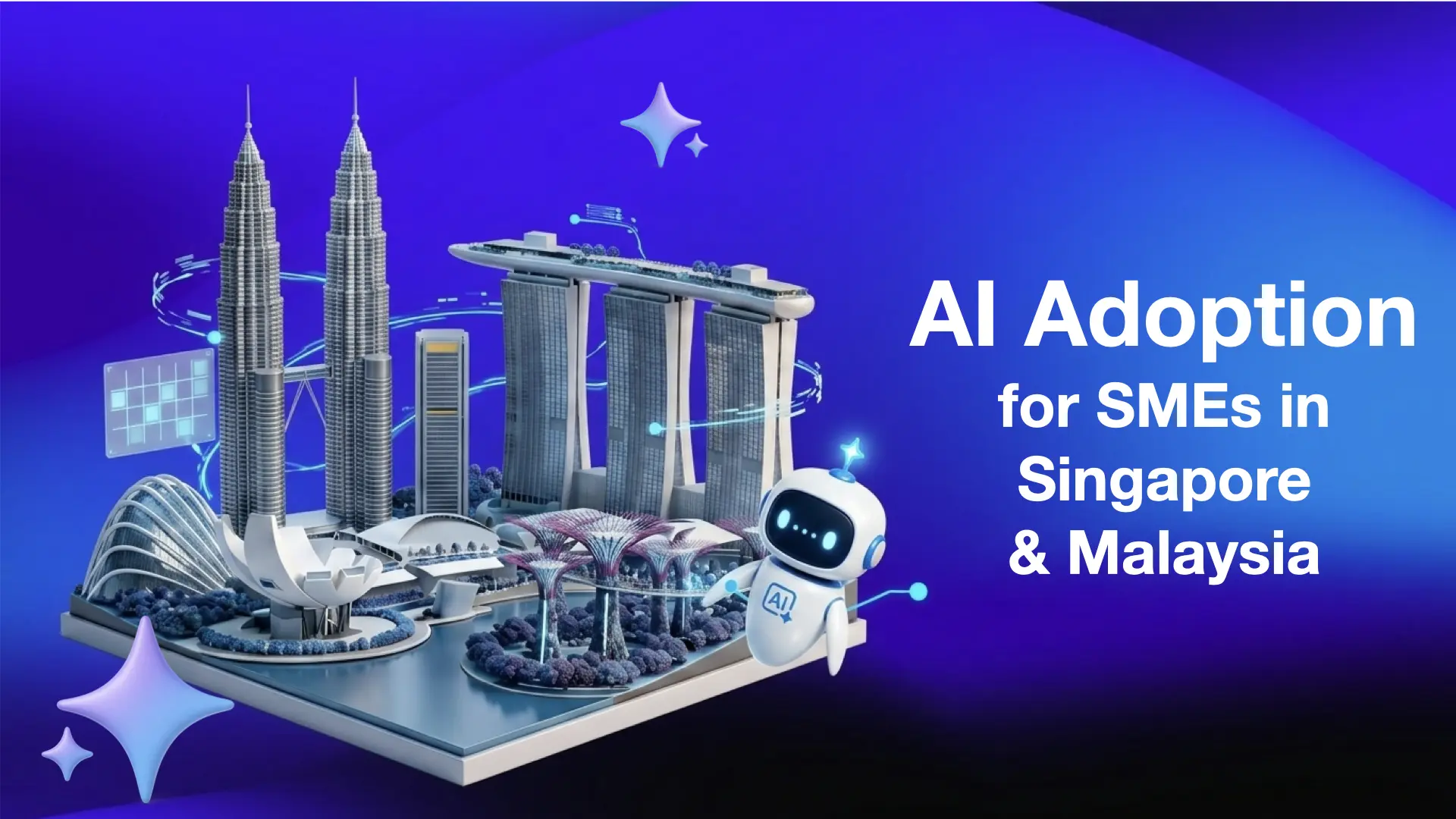
If you run a small or medium enterprise in Malaysia or Singapore, you have likely heard the same question echoing through boardrooms and WhatsApp groups alike: “Should we invest in AI now, or wait until it matures?”
Here is the short answer: Waiting is no longer an option.
2026 marks a pivotal turning point. The question is no longer whether your business will adopt AI, but how quickly you can move from experimentation to measurable impact. For SMEs across Malaysia and Singapore, this is the breakout year—and the window of opportunity is narrowing fast.
The Numbers Don't Lie: AI Has Gone Mainstream
Let us start with the data, because the data tells a story that every SME owner needs to hear.
In Malaysia, the numbers are striking. By 2025, approximately 27% of all businesses—representing roughly 2.4 million firms—were already using AI in some capacity. Even more remarkably, 81% of MSMEs reported some form of AI use. Among these adopters, roughly 65% reported higher revenue (averaging about 19% growth) and 72% reported productivity gains. These are not marginal improvements—they are game-changers.
The Malaysian government has recognised this momentum. Budget 2026 opened up RM50 billion in SME financing and guarantees specifically for AI-linked digitalisation. The National AI Action Plan 2026–2030 has made AI a clear national priority. Industry bodies are following suit—SAMENTA, Malaysia’s first SME association, has unveiled a 2026–2029 National Council with “Accelerated AI Integration and Digitalisation” as a core pillar, explicitly calling for moving “beyond basic digital presence to embed deep-tech capabilities and automated workflows into traditional SME operations”.
In Singapore, the acceleration is equally dramatic. According to IMDA’s Singapore Digital Economy Report 2025, AI adoption among SMEs more than tripled from 4.2% to 14.5% in just one year. Enterprise-wide AI adoption surged even more dramatically—from 4.3% in 2023 to 53.5% in 2025.
Singapore’s government has responded with unprecedented support. The inaugural SME AI Impact Awards 2026 will recognise up to 30 winners across two categories. The National AI Impact Programme aims to help 10,000 enterprises integrate AI into their business processes. The government has also refreshed the Retail Industry Digital Plan, with more than 2,000 SME retailers expected to benefit—and nine in 10 retail SMEs that have already adopted digital solutions reported productivity gains, reduced operating costs, and increased revenue.
But here is where it gets interesting—and concerning.
The Adoption Gap: Why Most SMEs Are Still Stuck
Despite these impressive headline numbers, a closer look reveals a troubling divide.
Singapore presents a stark picture of uneven adoption. In 2026, only 27.2% of smaller firms with fewer than 200 employees adopted AI, compared to 54.8% of mid-sized firms (200–500 employees) and a staggering 76.4% of larger firms with more than 500 employees. The gap between large enterprises and SMEs is widening, not shrinking.
Malaysia faces an even more concerning dynamic. While 81% of MSMEs report using AI, 62% of large enterprises have moved into “Deep Adoption” —meaning system-wide integration. Meanwhile, 81% of MSMEs remain stuck in “Shallow Usage” —using AI for basic chatbots or email drafting rather than embedding it into core business logic.
This is what experts call the “Surface AI” trap. Your competitor may claim to “use AI,” but are they actually transforming their business—or just dabbling?
The Pertama Partners SEA mid-market AI Adoption Index 2026, a comprehensive analysis synthesising data from McKinsey, IDC, Stanford HAI, and other major sources, places Southeast Asia’s overall mid-market AI adoption score at just 31 out of 100. Only 18% of Southeast Asian mid-market companies have progressed beyond pilot-stage AI projects into sustained implementation.
Eighteen percent. Let that sink in. More than eight out of ten mid-market businesses in the region are still stuck in the experimentation phase.
Even more telling: across ASEAN, a staggering 71% of SMBs are still doing tasks manually that could be fully automated. Business owners are spending 2–5 hours a day on tasks that could be automated. Lead lists go cold because follow-up is slow. Client reports take half a day instead of 28 minutes.
The barrier, as one observer put it, “isn’t technology. It’s not knowing where to start”.
The Hidden Costs of Waiting
Every day you delay AI adoption, your competitors are pulling further ahead—and the costs are mounting.
First, there is the compliance risk. MSMEs using generic, un-governed AI tools are unknowingly sitting on a 29% compliance risk. With regulations like PDPA 2.0 becoming stricter, using unvetted AI tools is not just inefficient—it is dangerous.
Second, there is the talent gap. According to Epitome data based on aggregated skills assessments across Singapore and Malaysia between 2023 and 2025, only around one in five professionals consistently demonstrate characteristics associated with AI-ready skills. The longer you wait, the harder it becomes to attract and retain the talent you need.
Third, and most critically, there is the opportunity cost. BCG’s AI at Work 2026 report—a global survey of 11,749 people across more than a dozen markets—found that 74% of frontline employees now describe themselves as regular AI users, up 23 percentage points in a single year. Among regular users, 42% of frontline staff report saving a full workday or more every week; for leaders, the figure is 60% saving at least eight hours.
But here is the kicker: 66% of employees said they receive limited or no guidance on what to do with the time AI saves them. More than half admit they do not redirect that time into more strategic work.
In other words, businesses are buying productivity gains—and quietly throwing them away.
Why 2026 Is Different: The Shift from Generative to Agentic AI
So why is 2026 specifically the breakout year?
Because we are witnessing a fundamental shift in what AI can do. The conversation is moving from generative AI (tools that create content) to agentic AI—autonomous systems that can plan, execute, and adapt multi-step workflows.
According to the Tech For Good Institute, “Agentic AI marks a shift from tools to autonomous systems that can plan, execute, and adapt multi-step workflows, enabling end-to-end automation in operations, customer service, and finance”. This is no longer about chatbots and email drafting. This is about AI that can manage procurement, handle customer onboarding, process invoices, and generate compliance reports—all with minimal human input.
The UOB Business Outlook Study 2026 found that 88% of businesses plan to increase AI budgets in 2026, despite only 15% having reached advanced capabilities. AI has moved “from experimental to operational”. Sixty-five per cent of businesses have adopted AI in some capacity.
The question is no longer if you will adopt AI—but how fast you can move from shallow usage to strategic integration.
The Opportunity: What Intelligent SMEs Look Like in 2026
What separates the 18% who have moved beyond pilots from the 82% who remain stuck?
The most successful mid-market adopters share identifiable patterns:
They start with clearly defined business problems rather than technology solutions.
They invest in data foundations before AI tools.
They pursue a disciplined “pilot-to-platform” strategy that compounds returns over time.
In practice, this looks like:
Office automation: AI-powered workflows that handle routine administrative tasks—payroll processing, leave management, invoice processing—freeing your team for higher-value work.
Marketing automation: AI that analyses customer behaviour, personalises outreach, and optimises campaign performance in real-time.
Customer service: AI agents that handle 40% or more of routine inquiries, reducing response times and improving satisfaction scores.
Decision support: AI that provides actionable insights from your business data, enabling faster, smarter decisions.
The results speak for themselves. Mid-market companies adopting AI report revenue improvements of up to 91%, and those with active AI deployments are 1.8 times more likely to experience growth than non-adopters.
Where Do You Start? Your AI Readiness Checklist
If you are reading this and thinking, “This all sounds great, but where do I even begin?”—you are not alone. The barrier isn’t technology. It’s not knowing where to start.
Here is a simple three-step framework:
Step 1: Understand where you stand today. Before you can plan where you are going, you need to know where you are. How visible is your business in the AI-driven search ecosystem? How do you compare to your competitors?
Step 2: Identify your highest-yield use case. Don’t try to do everything at once. Pick one core area—whether it is HR and payroll, customer service, or marketing automation—and focus on delivering measurable results there first.
Step 3: Partner with experts who understand your context. The most successful adopters don’t go it alone. They work with partners who understand the local market, the regulatory environment, and the unique challenges of SMEs in Malaysia and Singapore.
Who is JustSimple.AI?
At JustSimple.AI, we are a Malaysian AI Automation Agency dedicated to helping businesses navigate and thrive in this new era. We understand the unique challenges and opportunities of the local market, including considerations like regional search intent and the nuances of the Singaporean and Malaysian consumer base.
We don’t just offer generic tools; we offer transformation. Our team of experts helps you build and deploy these intelligent, semantic workflows, moving you from manual, outdated SEO practices to an optimized, revenue-focused system. We cut through the technical jargon and focus on one thing: getting your business found by both humans and AI models.
Your Next Step
The data is clear. The window is open. And the cost of waiting—in lost productivity, compliance risk, and competitive disadvantage—is only growing.
At justsimple.ai, we exist to make AI adoption simple, accessible, and effective for SMEs and corporate clients across Malaysia and Singapore. We understand that you don’t need more buzzwords—you need practical solutions that deliver measurable results.
Start by understanding your current position. Our Free AI Visibility Evaluation Tool gives you a comprehensive assessment of your AI visibility and competitive positioning—so you know exactly where you stand and where to focus your efforts.
Ready to go deeper? Our AI Vibe Coding Apps solutions are designed specifically for SMEs who want to accelerate office automation and marketing automation for better efficiency—without the complexity and cost of enterprise-grade solutions.
Not sure where to start? Book your free consultancy session with our team today. We will help you identify your highest-yield opportunities and build a practical roadmap to AI adoption that delivers real results.
The rise of the intelligent SME is not coming. It is already here. The only question is: will you lead—or will you follow?